
 Bergers Book Reviews offers a warm welcome to Debu Majumdar, who has stopped in today for a chat:
Where are you originally from? What brought you to the US?
I am originally from Calcutta, India, a city made somewhat infamous first by the controversial Black Hole of Calcutta and later by a novel, The City of Joy. Mother Theresa’s heart-felt activities for the dying and destitute finally put the city on everyone’s map of the world. Actually, it is a city that thrives with writers, musicians and artists and has produced three Nobel laureates (literature, peace, and economics) and musicians like Ravi Shankar and film directors like Satyajit Ray. So I am happy to be from Calcutta, now called Kolkata.
I came to the U.S. to do graduate study in physics. This was possible because the University of Pennsylvania provided me with a teaching assistantship that paid the tuition and money to live in Philadelphia.
What was the inspiration for Viku and the Elephant?
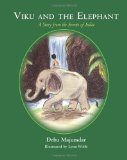
When they were young, our two sons loved to hear stories from India. Stories from far away India were mysterious and fascinating – stories of monkeys who throw fruits at you or snakes who hang like vines are indeed fascinating. I invented the character of Viku to entertain them. Viku grew up near a jungle and he was never afraid of animals. He was also a good boy. I think my sons associated with Viku as a hero and wanted to hear more of his adventures. They’d ask me to repeat the stories over and over again. Many years later, I thought that if my sons liked Viku, perhaps other children would also. So I wrote up the first story. Another thing that inspired me to write about Viku was that in my volunteer tutoring of school children I found that children here are unaware of the outside world and of other cultures. But the world is getting smaller and these children will grow up and likely interact and work with people from around the world. I want them to know about other cultures through simple stories.
How do you view human and animal interactions? Is it possible to truly be an animal’s friend?
Children growing up in India learn a lot from animal stories such as the Panchatantra and Jataka tales, where animals are portrayed as intelligent beings having human-like feelings. These children grow up sympathetic and respectful of animals. They do not, in general, think of animals as soulless beings and their first instinct is to not kill an animal, but rather to appreciate it. The predominant Hindu culture also supports this, as each god or goddess has a specific animal associated with them. For example, the elephant-headed god, Ganesh, is always portrayed with a mouse sitting at his feet. In this upbringing, human and animal interactions are gentle and friendly. There is little violence in this picture – certainly no interest in killing an animal to have it mounted on a wall. Now, this is a mental image, and cannot be true in the real world with wild animals. I am as afraid of predatory animals as anyone else! However, we know very little about wild animals. What do the animals think of humans? We do not know.
Domesticated animals, on the other hand, are a different story. Human beings can certainly be their friends, and the interesting thing is that animals can also be friends to humans. Dogs and dolphins have rescued and helped many people. Where would humans be without the help of domesticated cows and horses? We train dogs and elephants to do our work. Through our interactions with pets we learn empathy, trust, caring for others, and many such social values. They help us in to be better human beings.
My cat, Dooshtoo (the name means naughty), was waiting outside the door of my study until my wife let her in. She comes to me and when I say, “Come,” she climbs on my lap and sits with me while I write. She nudges me occasionally to pat her. If this is not friendship, I don’t know what else it could be between a man and a cat.
Viku and Haatee face evil men, successfully thwarting their actions. What advice would you give kids facing problems in their own lives?
Viku could not have defeated the ivory thieves without the help of his elephant friend, Haatee. This was possible for two reasons: first, he understood his friend very well even though Haatee couldn’t talk; and secondly Haatee was very smart. Viku tried to plead with the bandits, but that did not work. Viku and Haatee did the best thing they could do at the time. Viku did not know how their problem would be solved, but he kept his mind open and in the end a solution emerged. They came out victorious.
So when you face difficulties, big or small, do not give in to fear, keep your wits – your intelligence. Try your best not to feel despair or hopeless. Then firmly remember that good will always win over evil in the end. A solution will emerge. Make the best decision you can make and search for other solutions – always keep your mind open for a new way to get out of the problem. If you give up or cave in, no help can come to you.
Do not hide away from problems such as someone bullying you or telling you something that you do not like or want to do; talk with friends and adults – with more than one adult if possible. Do not remain silent and keep your problems inside you. Many problems will go away if you are able to talk with someone.
Your book is set in India, which is an important element of the story. Would you like to share with us a special Indian holiday tradition or a memory of an important event?
‘Thirteen festivals in twelve months’ is a common saying in India. So growing up in India with many festivities is wonderful. And in my childhood (in the fifties) when all vegetables and fish were not available throughout the year, the festivals brought new meanings with different food items and sweets. For example, tomatoes, cauliflower, peas, etc. came only in winter in India and, similarly, summer brought other vegetables (some still not available in the U.S.) and fruits such as mango, litchi, etc. Mothers made different sweets for different festivals and we looked forward to those times and treats.
I will write about one festival today – kite flying day – when the sky fills up with kites of all colors. It is a day all boys and many men get very excited about. There will be kite fights that everyone prepares for many days before the festival. The trick is to make your kite string sharp and knife-like by pasting glass powder on it with special glue. When the string is dried in the sun, it can easily cut your fingers, so one has to be careful during kite flying. You can bring your kite near any other kite in the sky and go under or over its thread and cut the opponent’s string by pulling your string very fast. Of course, we develop expertise in maneuvering a kite in the sky. We could move it in any direction very quickly. No one can complain about a kite fight, especially on kite flying day, and the defeated kite falls down – free for anyone to grab it. Running after a falling kite is also great fun. Once running with a group of boys, I caught the string of a falling kite, but alas, a taller person caught the string above me and ran away with it. Finder’s keepers. We usually fly kites from the roof (buildings have flat roofs – with a short wall around the roof top patio) and also from the ground, and what fun kite-flying is! In the eastern part of India, kite-flying day is the day of worship of the god who is the patron of engineering.
Have you written other books, or are there any in the works?
I wrote a creative non-fiction book, From the Ganges to the Snake River – an East Indian in the American West, which was first published by Idaho State University and later by Caxton Press in 2000. It is autobiographical and is based on my experience in Idaho. The book interweaves Indian culture with North American reality. A reviewer said, “It gives a tender, often amusing account of a stranger in a strange land. With each piece I found myself laughing out loud and curious to read more…” Four chapters from this book were reprinted (from all publications by Rendezvous from 1966 – 2005) by the Idaho State University Department of English and Philosophy in their Memorial volume titled Rendezvous: Forty years of History, Politics and Literature of the West.
My next book will be a sequel to “Viku and the Elephant” and is tentatively called “Viku Comes to the Rescue.” Hopefully it will come out in 2012. Themes of this story entail a spirit of not giving up, perseverance, cleverness, and punishment of the bad guys.
Is there anything else you’d like to share with us?
I grew up with stories – all kinds of stories – animal stories, scary stories where female demons eat people up, ghost stories, mythological stories, and stories of gods and goddesses. Many of these stories teach good ethical values – primarily compassion and right things to do. The world is getting smaller and when the children of today grow up, they will meet and work with people from different parts of the world. I’d like our children to read stories from different lands so they will better understand other cultures and points of view. Viku and the Elephant is one such story. I wish all children read it.
Thanks for visiting with us today, Debu!










 Bergers Book Reviews